Commercial new construction
Commercial new construction electrical
Electrical systems for new commercial buildings across Hutto, Austin and Williamson County, quoted competitively so an owner or general contractor can compare the number against anyone else's.
Chapter 01
The price that changes when the drawing does
A commercial electrical bid is priced against a drawing set, and a drawing set is not a finished building, it is a general contractor's best guess at one on the day the bid went out. By the time the job is actually under roof, a wall has moved eight inches for a code clearance, a tenant has swapped a stockroom for a break room, or the equipment schedule has changed because the actual fryer or compressor that got ordered draws different amperage than the one the drawings assumed. None of that is unusual. It is just what a real build looks like once people other than the electrician start making decisions.
The expensive version of that problem is the one nobody notices until the walls are closed. Rough-in is the point where boxes, conduit runs and circuit capacity get decided, and once drywall goes up over them, changing your mind costs a demo crew as well as an electrician. A panel sized for the tenant on the drawings, not the one who actually signs the lease, is a problem that gets discovered by whoever leases that space next, usually mid-fit-out, usually on a deadline.
We quote new construction jobs competitively so an owner or general contractor in Hutto, Round Rock or anywhere across Williamson County has a real number to compare against, not the only number they have ever seen. Comparing quotes on a job this size is normal, and we would rather earn it on the number and the work than assume we already have it.
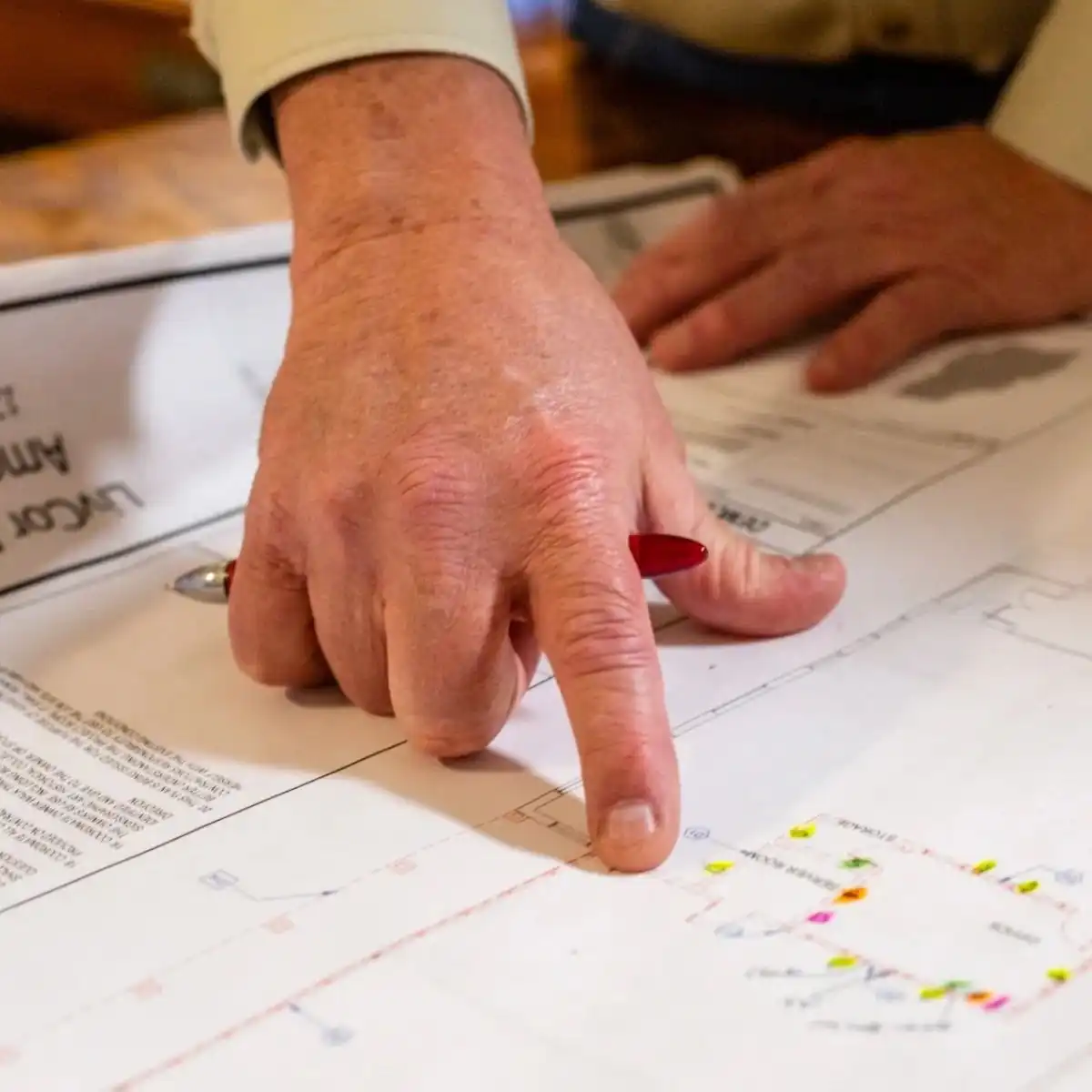
A hand pointing at panel and wiring markups on a printed new construction floor plan
Rough-in first, gear after, inspection last
Rough-in happens before the walls close: box and conduit runs for plugs and switches, CAT5 for TVs, phones and data, 220V receptacle runs, dedicated circuits for known equipment, and the wire paths for whatever lighting and exhaust fans the space needs. Getting this sequence right the first time is the difference between a job that finishes on schedule and one that gets reopened later at somebody's expense.
Once the service size is confirmed, panel and meter sets go in on Square D, GE or Eaton gear, sized for the building's real load rather than a placeholder from the drawings. Many commercial spaces, restaurants and retail among them, run on 3-phase power for the mechanical and equipment loads a single-phase residential service was never built to carry, so that gets planned into the rough-in from the start rather than added on afterward.
Modular furniture hook-ups are their own headache on a commercial job, because the furniture layout is frequently the last thing finalized, often after the walls are already closed, which means the whip circuits and floor boxes that feed it have to be planned for a layout that has not been picked yet. We coordinate the rough-in, the panel work and the final inspection around the general contractor's schedule so the electrical is never the reason a certificate of occupancy gets held up, and we carry the same GFCI, AFCI and hot tub or spa power scope into commercial builds that call for it as we do on residential work.
Chapter 03
The warranty that outlives the punch list
Every job, commercial or residential, carries a one year warranty on material and labor. On new construction that matters past the punch list walkthrough, because the first heavy load a panel actually carries is often the tenant's, not the general contractor's, and that can land months after handoff, well past the point most contractors have moved on.
The other thing worth knowing before you pick a contractor for a new build: the same crews that wire the building new tend to be the ones who come back for the remodel five years later, once a tenant changes or the fit-out ages out. That continuity is worth something. An electrician who remembers why a circuit was run a certain way finds a problem faster than one meeting that panel for the first time on a service call.
That is also why the commercial client list below is worth reading past the names. Firestone Auto, Sonic Drive-In, Sotaesan Center, Store House Storage and Wells Fargo are jobs we finished, not logos we are borrowing, and several of them are the kind of multi-location accounts that come back when the next store in the chain needs the same work done the same way.
TVs, phones, data and CAT5, ceiling fans, 220V receptacles, panel and meter upgrades, hot tub and spa power, GFCI, aluminum wire connections, 3-phase wiring, breakers and panels, modular furniture hook-ups, AFCI breakers, exhaust fans, plugs and switches, dedicated circuits, troubleshooting. One call, one crew, competitive quotes for price comparison.
Recent commercial builds
Projects we can point to directly.
This is our own job list, not a stock description of the work. Project locations have also run through Elgin and Leander on jobs where the tenant name below does not apply.
- Firestone Auto
- Round Rock
- Sonic Drive-In
- Austin, Canyon Lake, Cibolo, Del Valle, Kyle, San Antonio
- Sotaesan Center
- Round Rock
- Store House Storage
- Waco
- Wells Fargo
- Austin, Bee Cave
A building does not stop needing electrical work once the ribbon is cut. When a tenant changes or a fit-out ages out, the same job usually turns into a remodel and repair call, and if the building's own electrical service was never sized right to begin with, that is a service upgrade or rebuild rather than a repair. Retail buildings and multifamily properties with their own lots also come back to us for parking lot lighting once the building itself is finished and the site around it needs the same attention.